Tuesday, 19 January 2021
Sound and Games
Monday, 18 May 2020
Once upon a summer, 1985
There were three buses from Nungambakkam to Mount Road: 25,
25B and 17c. On every day of the week in the summer of 1985 (except on
Mondays), I would be standing at the Nungambakkam Police Station bus stand, at
about a quarter past ten. The journey from there to the TVS stop wasn't long,
but buses weren't always reliable, and it would be a little before eleven that
I would find myself waiting, along with several others, on the stairs of the
British Council, waiting for the library to open.
This was a Madras summer, and it was a physical thing. The
air was like hot syrup, and your shirt would stick to your back as you waited,
and when the doors finally opened, you would walk into the blessed coolness of
air-conditioning. For me, that summer, it was heaven.
Library membership cost Rs 80 a year, and you could borrow up to four books
at a time. Cards were issued by a slender, distinguished-looking woman with
short, iron-grey hair with improbably beautiful diction.
There were books I borrowed from there, of course. There
were Wodehouses, pretty much the entire
set - but you could seldom find them on the shelves, as people would ransack
the carts the library staff used to take returns to their proper locations. So
you had to reserve them, which meant looking up the card catalogue, finding the
proper number and filling out a form, and later you would get a postcard when
the books were available, telling you to pick them up within so many days. I
remember making a reservation for Bill the Conqueror, and being delighted when
the postcard finally came - and being ultimately disappointed, as the book
wasn't as good as many of Plum's best. There were the Orwells, and for some
reason, I never read his novels. I consumed his essays, though, fascinated,
even then, by the depth of his perception and the clarity of his language and
worldview.
But it wasn't for those books that I was at the library for.
It was for the part of the library which housed a few TV sets, and you could
get one of the staff to load up a David Attenborough documentary, and marvel at
the glories of the planet. Or it could be an episode of Fawlty Towers, or some
other show, and you'd realize that you were laughing only when you caught some
other member's disapproving stare.
But most of all, I lived for the reference section.
It took up almost a third of the library. There were
comfortable chairs all around, and the space was punctuated by shelves. There
were magazines - music, mechanics, automobiles and current affairs. There were
week old English newspapers that some older members would read, religiously.
There were encyclopaediae on a variety of topics. And there were the film
guides.
I hadn't been very
much into film at that point. After all,
the only major English films that came to Madras were James Bond thrillers, a
year after release in the West. This was the time when the biggest grossing
film in India - for several years - had been MacKenna's Gold. I had watched a
few Bond films - the ones that had come to the theatres, and loved them. And of
course, I'd watched Raiders of the Lost Ark.
I think that I pulled out a film guide to see if there were
other films she had acted in. This being
the British Council, you wouldn't find Maltin's guide - which was available in
the bookshops. But I'm pretty sure that what I initially looked through was
some run of the mill film guide.
I'm not sure when I first came across Leslie Halliwell's
guide. But it was unlike any of the others. Dense, without pictures - imagine a
film guide without a single still, it seemed heavy going. And there was the severity of judgment. Pages
and pages of films without a star rating. I looked up Raiders of the Lost Ark.
Two stars.
Two Stars.
It was one of the
greatest movies I'd seen, and all it got was two stars?
I looked at the Bonds.
The Spy Who Loved Me?
No stars.
What???
So who was this guy? Some arty type who only rated Oscar
movies?
I checked Gandhi - which had won the Oscar recently, to
front page coverage in every Indian newspaper.
Three stars.
Not expecting very much, I looked up From Russia, with Love.
Three stars, the same as Gandhi.
Description: "Arrant nonsense with tongue in cheek, on
a big budget"
Every day after that, except on Mondays, when the library
was closed, you'd find me there, deep in Halliwell's Film Guide, 4th edition,
and later the 5th. Sometimes, someone would be sitting in my favourite chair,
and I would glare and glare, and reclaim it at the first opportunity. Somedays,
I would go with a notebook, and make list of films that I would see, when I got
the chance.
And when I was sated with reading about old films, and
Hollywood's golden age, I would leaf through magazines. Or watch a show.
And soon, it would be evening, and I would reluctantly close
the guide, and head back to the bus stop, wondering if I would ever be able to
see all the films that I wanted to. And as the bus made its way to
Nungambakkam, I would slowly emerge from a world black and white and colour,
where Errol Flynn would battle Basil Rathbone on the stairs of Nottingham
castle and Bogey would have one more drink and Cary Grant and Rosalind Russell
would scheme and manipulate each other and every one else, into a world of
public exams and IIT preparation and all the rest, far away though it seemed at
the time.
Monday, 6 April 2020
Guilty Pleasures: James Hilton
I don't quite remember when I first read Random Harvest, but I'm quite sure this was after I became interested in the Golden Age of Hollywood. Halliwell had given it three stars, and the movie itself was hokum, but sincerely done, with a magnificent cast.
It was only later that I really read it, and I found I enjoyed it very much.
Charles Rainier is an industrialist and a Conservative MP, to all intents and purposes, a very successful man, with a lovely wife who is also an accomplished hostess. But there's something that he's missing, an emptiness that he has been trying to fill in his life.
We learn that there is a gap in his memory, a period of three years he remembers nothing about, three years that took place after he was wounded in the great war, and then he woke up in 1920, recovering from an automobile accident, with no memory of what happened to him, from 1917 to the moment he regains consciousness from the accident.
The story is about how he tries to to recover those memories, but its also about the period between the two world wars. Chronologically, the story begins with Armistice Day, 1917, and ends on September 1, 1939, and the picture it draws of England between the wars is fascinating.
Rainier is upper middle-class, and after rejoining his large family, decides to go to Cambridge - something he thoroughly enjoys, but he gives it up to take control of the family businesses.
It's a portrayal of the English upper classes that's a great deal more affectionate than, say Waugh, even though there are characters who could move seamlessly between the two worlds.
Jill could afford once more her cruises and flirtations, with no handicaps to the latter except advancing middle age and none to the former save an increasing difficulty in finding new places to cruise to. Julia and her husband lived in Cheltenham, playing golf and breeding Sealyhams; George and Vera preferred town life and had taken a newly built maisonnette in Hampstead. Julian was at Cannes, doing nothing in particular with his usual slightly sinister elegance; once or twice a year he turned up in London, took Charles for lunch to the Reform Club, and worked off a few well-polished epigrams. Bridget had married an officer in an Irish regiment and lived in a suburb of Belfast. She had had one child, a boy, and was expecting another. With George's girl and Julia's boy and girl, this made a problematical five as against seven of the previous generation, unless (as Chet put it) Charles hurried up. They were not, however, at all anxious for Charles to hurry up; and as both Lydia and Jill were past the age when any amount of hurry might be expected to yield result, and as Vera was sickly and Julia (so she boasted) had nothing to do with her husband any more, the ratio really depended on Bridget—plus, of course, an outside chance from Charles. Nobody even considered Julian in such a connection.Hilton's prose is simple - and surprisingly economical. It doesn't thrust itself forward, but with a couple of sentences, he establishes the characters of Charles' family, individually and as a unit.
There's also the Al Stewart aspect - who I kept thinking of as I read the novel. Many of Stewart's songs - Post World War II Blues, A League of Notions, Trains - all take you through periods of history, painting pictures with a few words, and deceptively muzak-sounding music, until you realize that there's a considerable amount of artistry behind it. It's much the same way with Hilton. And this is about an England between 1917 and 1939. The very next paragraph to the one above switches from the personal to the political.
Much more, though, had happened between 1921 and 1924. The ancient Irish problem had apparently been settled; a conference at Washington had arranged limitation of naval armaments between England, Japan, France, and the United States; someone had almost climbed Everest; the German mark had collapsed and French troops had entered the Ruhr; Mussolini was rebuilding Italy and had already bombarded Corfu; there had been an earthquake in Japan, there had almost been another war with Turkey, there was still a war in Morocco, and there was going to be an exhibition at Wembley.And through it all is Charles Rainier, a decent man, but also, like so many of Hilton's heroes, curiously passive. Not to suggest that he isn't capable of action, quite the contrary, but it is disinterested action - a very Bhagavad Gita kind of action. He's as much observer as doer.
Hilton was a bestselling author in his time, and many of his books were filmed. And one of the greatest advantages he had were the actors who portrayed his heroes were definitive examples of decent, gentle Englishmen - Robert Donat in Knight without Armour and Goodbye Mr Chips, and Ronald Colman in Lost Horizon and Harvest. And their performances do so much to cement the idea of the decency of heroes.
![]() |
| Donat and Dietrich in Knight Without Armour |
![]() |
| Colman as Rainier and Garson as Paula Ridgeway in Random Harvest |
Nineteen twenty-five was another improving year, the year of Locarno, the false dawn. It was a year perhaps typical of the twenties in its wishful optimism backed by no growth of overtaking realism; another sixpence off the income tax, another attempt to harness a vague shape of things to come with the even vaguer shapes of things that had been. For the public would not yet look squarely into that evil face (publishers were still refusing "war books") and few also were those who feared the spectre might return. The England hoped for by the majority of Englishmen was a harking back to certain frugalities of the past (lower and lower income tax, smaller and smaller government expenditure) in order to enjoy more and more the pleasures of the present; the Europe they dreamed of was a continent in which everybody placidly "saw reason," while cultivating summer schools, youth hostels, and peasant-costume festivals in the best tradition of Hampstead Garden Suburb; in exchange for which the City would make loans, trade would thus be encouraged, and taxes fall still further. Mixed up with this almost mystic materialism was the eager, frightened idealism of the Labour Party (both the eagerness and the fright came to a head a year later, in the General Strike); the spread of the belief that the League of Nations never would be much good but was probably better than nothing, a belief that effectively converted Geneva into a bore and anyone who talked too much about it into a nuisance. Meanwhile a vast and paralysing absence of hostility gripped Englishmen from top to bottom of the social scale, not a toleration on principle but a muteness through indifference; they were not AGAINST the League of Nations, they were not AGAINST Russia, they were not AGAINST disarmament, or the Treaty of Versailles, or the revision of the Treaty of Versailles, or the working classes, or Mussolini—who had, after all, made the Italian trains run on time. "
I've called Hilton a "guilty pleasure", and I have often wondered why. I've read worse writers with pleasure and have made no bones about it. I sincerely believe that guilty pleasures are signs of snobbery (not that I'm immune to snobbery myself, but I try to guard against it myself ). But sometimes I feel embarassed that I like Hilton. Maybe it's because of the exaltation of a certain kind of Englishman, a certain kind of Englishness - which as an Indian, I instinctively distrust.
Consider this bit.
The very absence of all these things was English, Rainier said—something offhand but good-humoured, free but obedient, careless but never heartless.Naturally, as someone from one of England's former colonies, this irritates me.
"But tell that," he added, "to the Indians in Amritsar, to the Chinese who read the notice in a Shanghai park, 'No Dogs or Chinese Allowed,' to the tribesmen in Irak, to the peasant in County Cork, to the..." But then he laughed. "God, how we're hated! It isn't so much because we really deserve it. Even at the bottom of the charge-sheet I could quote Santayana's remark that the world never had sweeter masters. SWEET—a curious adjective —and yet there IS a sweetness in the English character, something that's almost perfect when it's just ripe—like an apple out of an English orchard. No, we're not hated altogether by logic. It's more because the world is TIRED of us—BORED with us—sickened by a taste that to some already seems oversweet and hypocritical, to others sour and stale. I suppose the world grew tired of the Romans like that, till at last the barbarians were excused for barbarism more readily than the Caesars were forgiven for being tough. There come such moments in the lives of nations, as of persons, when they just can't do anything right, and the world turns on them with the awful ferocity of a first-night audience rejecting, not so much a play it doesn't want, as a playwright it doesn't want any more... But wait till they've experienced the supplanters—if we are supplanted. A time may come when a cowed and brutalized world may look back on the period of English domination as one of the golden ages of history..."
But then, the India I live is the India of Delhi in 1984, of Gujarat in 2002 and Delhi in 2020.
"But wait till they've experienced the supplanters—if we are supplanted. A time may come when a cowed and brutalized world may look back on the period of English domination as one of the golden ages of history..."
And I wonder.
Thursday, 19 March 2020
The Nameless King
And over the course of four days last week, I've played a certain section of a game over and over and over.
The game is Dark Souls III. If you're into games at all, you know what I'm talking about. If you aren't, well, it's a fiendishly hard game. But, it's also fair. It requires, atleast in the initial playthroughs, a lot of caution, and a lot of dying.
Souls games begin with you waking up undead, and navigating a short tutorial section, before you face a boss enemy - to whom you will die a few times, before making your way to the game's hub area.
From there, you go on, looking for the MacGuffins - bells to ring, items to collect, and at the end of each area is a boss - usually a punishingly hard boss. And you die, and you run the "gauntlet of misery" back to the boss, until you manage to survive the encounter.
I spent four days - around twenty hours - just fighting one of them.
In the game's mythos, he is the exiled son of the thunderbolt wielding prime deity. This world survives because of the first flame, which provides heat and light, and keeps darkness at bay. And in the beginning, Gwynn, the God of Thunder defeated the primordial dragons, but his eldest son, and the Gods' greatest warrior, betrayed them, and joined the dragons instead. He was banished, and all records of his existence were destroyed.
He is the guy I spent all those hours fighting.
The run-up to the fight is epic in itself. The area is called Archdragon Peak, and you battle your way through vicious serpent-men who can destroy you in a couple of hits. You run past one dragon that lands in your path, weaving through ruins filled with enemies, dodging gusts of fire when you get out in the open, until you get to a point where you can strike at the dragon's weak spot. Then you toil up a mountain side face off against another dragon and another horde on enemies, until you find a safe spot next to a giant bell.
You walk up to the bell, and pull a lever. The bell tolls, and thunderclouds gather. Gather may be too mild a word - they boil around you. One moment, its a clear sunny day, the next, your standing on a vast cloud, and in the distance, a speck gets bigger and bigger - until you see that its a massive dragon, with a man perched on it.
Then the music starts, as the dragon swoops towards you. And its rider lifts up a massive spear, crackling with lightning.
Progress in most games - be they racing or sports or FPSs - is all about pattern recognition, and how quickly you respond. It all comes down to seeing cues, and pressing the right buttons.
The build up to the boss fight - or level - is designed to teach you what you need - which cues to look for: which moves are one shots; which cues presage the beginning of a combination of obstacles/threats; which moves require instinctive responses; which cues need just that bit of delay before you respond, and so on.
But what makes the King so hard is that he has a huge variety of cues - in this case attacks. Most of them are telegraphed, but figuring out what each cue means, and how to respond to it - decisions on whether to dive away or sidestep, to dive once or multiple times, whether to move towards him or away, linearly or diagonally - have to be made instinctively. And add to this the fact that you lose sight of him when some of his rushing attacks move him behind you, and you're frantically turning around to figure out where he is, while he's lining up a devastating strike.
Dark Souls is known for its punishing bosses - a tradition that goes back to its first edition, where players encountered the formidable duo of Dragon Slayer Ornstein and Executioner Smough. And the Nameless King is probably the hardest boss in the series - which includes the three Souls Games, Bloodborne and Sekiro. One of the most popular comments in the video of the Ornstein and Smough fight goes something like this: "So this is how it sounds beyond 10 seconds".
Fighting the Nameless King, I felt that comment.
The first time I went in the dragon wrecked me. The the king pounded me to a pulp with his great spear. Then the dragon burnt me to a crisp.
I tried again.
I died in 10 seconds.
Again.
15 seconds.
Again.
45 seconds, and almost killed the dragon.
Again.
Dead in 5 seconds.
This went on for an hour, before I killed the dragon.
Then this happened.
The first time wasn't too bad. I was able to keep myself alive, and waiting for openings, would risk the odd attack. I kept chipping away at his health bar, and got it halfway down.
And then I got greedy.
And he curb-stomped me.
It took me another day for me to beat the first portion - the dragon part consistently. Even then, one wrong move, one bad reposition, and I would die.
I started getting to the second phase more consistently, but I never did as well as I did the first time around.
I think the first time, I was more open-minded - more willing to play it safe because I didn't know his patterns, more alert because I didn't know what to expect.
Later, it was all "Oh shit, he's going to do this deadly attack and I should be really far away", panicked moves, and then he would switch up his attack and eviscerate me.
Over and over again.
For three days.
I looked at videos of the battle on the internet. I tried ranged attacks. I tried tanking. The end result was the same.
"YOU DIED"
Finally, I posted a plea on reddit. One of the suggestions was that I rebuild my character for this fight.
I did that - it was a completely new playstyle, one that I wasn't accustomed to, but I felt a lot sturdier. I had been, to use TVTropes jargon, a fragile speedster/glass cannon. Now I was the mighty glacier.
It was over in 3 minutes.
When the king finally collapsed, I didn't feel much. I thought to myself, "That's done".
It was only later, when I thought back about the boss battle, that a feeling of relief seeped through me.
Now I could get on with my life.
And maybe next time, I would defeat the king as a fragile speedster. That would be the real test.
But for the whole day and the next, I really felt like this.
Monday, 24 February 2020
My Ulysses Read - Proteus (1)
I finished Proteus, the third chapter in Ulysses a week ago. And read it again.
The first time, I read it mostly online, at The Joyce Project. The second time, it was the book version.
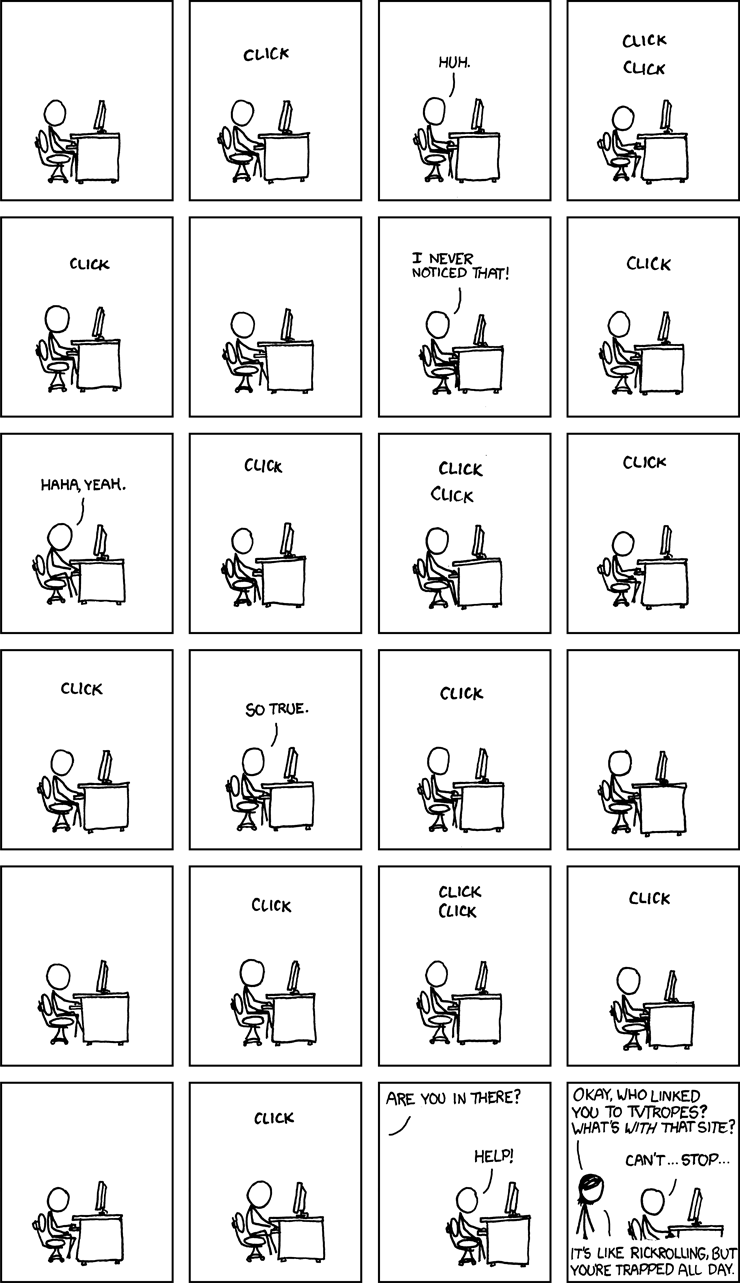
There's a world of difference. The online version is hyperlinked (in fact, its one of those charmingly old-fashioned sites, relying on plain html - the kind you hardly see any more) - and is extremely distracting, because you tend to go down - not a rabbit hole, but an absolute warren.
(Obligatory XKCD)
Reading the chapter in the book is very different - because you go through the narrative, pausing only to underline and mark stuff to look up later.
Nebeneinander Nacheinander
I'm wondering why I'm doing this. I am a literary snob, but an inverse snob. Given a choice between Edgar Wallace and David Foster Wallace, I will always go for the Feathered Serpents, the cabal of Just Men, and Mr Reeder with his rolled up umbrella. I would rather read Agatha Christie than Virginia Woolf, Lawrence Sanders than DH Lawrence, PG Wodehouse and Dashiell Hammett over everybody else.
So why am I trying to read Joyce? He's famously literary, loved by critics, very much part of the canon. And a modernist. And I wonder - is it some kind of snobbery that makes me want to read it?
I wasn't so close-minded before. When I was in college, I read reasonably omnivorously. Reveled in Stephen King and Tolkien and Conan Doyle, but also read the Castle and the Trial. We read Chaim Potok and Bernard Malamud and Scott Fitzgerald and Hemingway (I can still hear Macho repeating the name 'Potok' with childish glee). I remember getting into TS Eliot after listening to Highway 61 Revisited, and from there, via Christopher Ricks to Howl and Moloch.
Somehow - maybe as a result of the serious readers I met in later in real life - I closed myself off. I stuck to pulp and crime, genre fiction and comic books - a luxury for someone growing up in pre-liberalization India, where the superhero stories you read came in comics published by Chandamama.
As I wrote earlier, maybe reading Joyce would be like playing Dark Souls, where the sheer brutality of the gameplay kept you from the payoffs of mastering enemies and their moves, figuring out attack patterns of the bosses - to that final feeling of achievement you got when Gwynn (or Gehrman in Bloodborne) finally collapses and the achievement dings on the top of your screen.
This diffidence I feel about Ulysses, this fear of my own pretentiousness, also makes me question my own enjoyment of the book. It took me a lot of listening to classical music before finding pieces that I liked - the choral was probably the easiest to like, but going from there to the Goldberg variations or the Nocturnes or Mahler's 9th took me a long time - and these are pieces generally understood to be much more accessible than - oh I don't know - a Stravinsky. And when I'm reading, something at the back of my mind wonders "Am I trying to acquire a taste?"
And I suppose the answer is - "If you're enjoying it, go for it".
And I am enjoying it. Not in the way I enjoy Hammett, where the terse prose rushes me through tales of greed and violence; not in the way I enjoy Pratchett, where he makes me grin - just before he makes me think; not in the way I enjoy Wodehouse, where laughter is the effect of sheer, effortless mastery of the language. Reading Joyce (with references) is like reading a solved cryptic puzzle, and you see the kind of effort that went in only when you understand how the clues fit in.
Nebeneinander Nacheinander
I'll probably write more about Proteus, but at the end of it - I came away with an impression of having read something beautiful. And the words Nebeneinander Nacheinander are a part of that. The words are a reference to Gotthold Lessing's Laocoon: On the Limits of Painting and Poetry. "[Lessing’s Laokoon distinguishes] between poetry, which deals with objects one after another in time (nacheinander…), and sculpture and painting, which deal with objects next to one another in space (nebeneinander)"
Space and time.
Close up and long shot
Cross-section and time series
Stop and go
Balance sheet and P&L
Nebeneinander and Nacheinander.
It's become a mindworm, a thought-equivalent of a earworm, and now I'm trying, like Stephen, to shoehorn every duality into these two words.
The other thing about Proteus, especially with Stephen on the beach, is that this is so close to my experiences of being stoned. There's an appreciation of the world around, thoughts like an explosion of stars in the firmament of the mind - but one following the other. (Nebeneinander, Nacheinander). There's the sudden paranoia at the sudden appearance of the dog - the live one - the distant interest in its activities, and the spiraling back to dead mother, unknown woman and daydream of desire, a flash to the sensuous, of breeze on the face, remembered quotations (Full fathom five thy father lies - which sent me on to Eliot who used "Those are pearls that were his eyes, and from there to Hitchcock, whose Rich and Strange I saw in the British Council oh so long ago)
Since this isn't a book in the conventional sense - I don't think I will go to the next chapter just yet.
I'll read Proteus again.