My Ulysses Read - 3
I finished Proteus, the third chapter in Ulysses a week ago. And read it again.
The first time, I read it mostly online, at The Joyce Project. The second time, it was the book version.
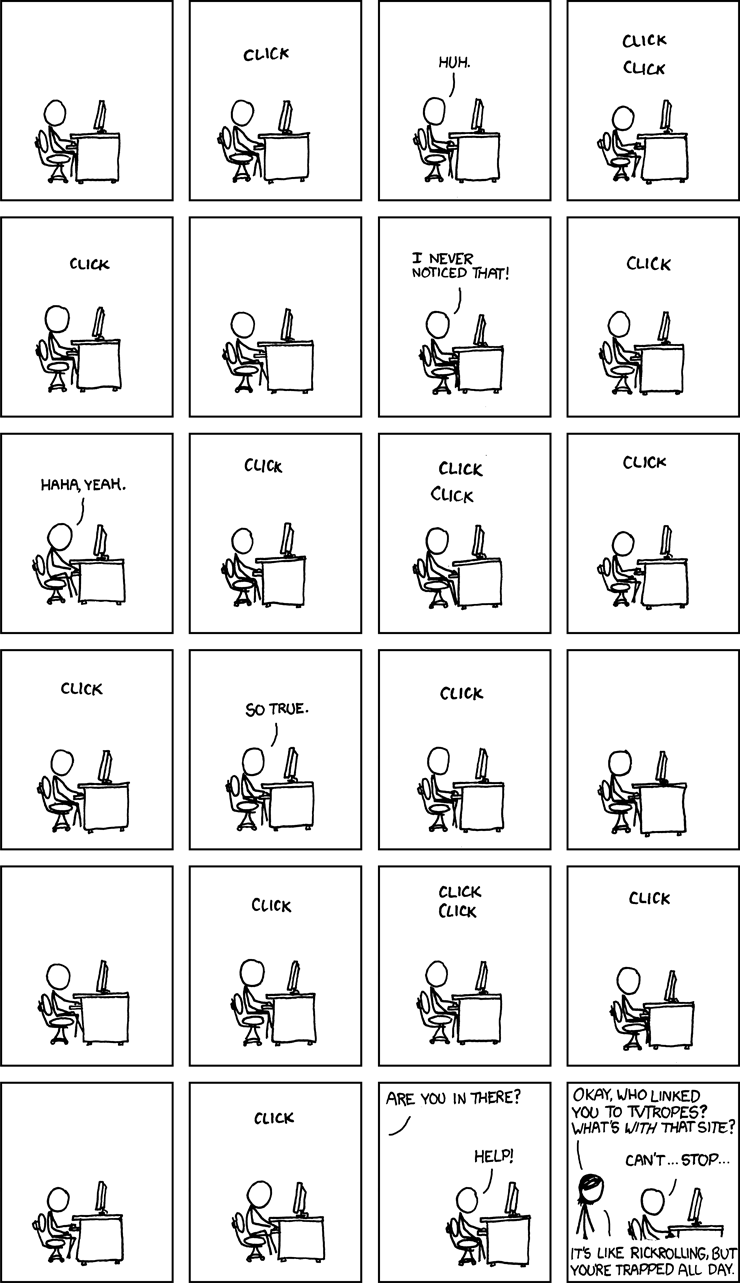
There's a world of difference. The online version is hyperlinked (in fact, its one of those charmingly old-fashioned sites, relying on plain html - the kind you hardly see any more) - and is extremely distracting, because you tend to go down - not a rabbit hole, but an absolute warren.
(Obligatory XKCD)
 Reading the chapter in the book is very different - because you go through the narrative, pausing only to underline and mark stuff to look up later.
Nebeneinander Nacheinander
I'm wondering why I'm doing this. I am a literary snob, but an inverse snob. Given a choice between Edgar Wallace and David Foster Wallace, I will always go for the Feathered Serpents, the cabal of Just Men, and Mr Reeder with his rolled up umbrella. I would rather read Agatha Christie than Virginia Woolf, Lawrence Sanders than DH Lawrence, PG Wodehouse and Dashiell Hammett over everybody else.
So why am I trying to read Joyce? He's famously literary, loved by critics, very much part of the canon. And a modernist. And I wonder - is it some kind of snobbery that makes me want to read it?
I wasn't so close-minded before. When I was in college, I read reasonably omnivorously. Reveled in Stephen King and Tolkien and Conan Doyle, but also read the Castle and the Trial. We read Chaim Potok and Bernard Malamud and Scott Fitzgerald and Hemingway (I can still hear Macho repeating the name 'Potok' with childish glee). I remember getting into TS Eliot after listening to Highway 61 Revisited, and from there, via Christopher Ricks to Howl and Moloch.
Somehow - maybe as a result of the serious readers I met in later in real life - I closed myself off. I stuck to pulp and crime, genre fiction and comic books - a luxury for someone growing up in pre-liberalization India, where the superhero stories you read came in comics published by Chandamama.
As I wrote earlier, maybe reading Joyce would be like playing Dark Souls, where the sheer brutality of the gameplay kept you from the payoffs of mastering enemies and their moves, figuring out attack patterns of the bosses - to that final feeling of achievement you got when Gwynn (or Gehrman in Bloodborne) finally collapses and the achievement dings on the top of your screen.
This diffidence I feel about Ulysses, this fear of my own pretentiousness, also makes me question my own enjoyment of the book. It took me a lot of listening to classical music before finding pieces that I liked - the choral was probably the easiest to like, but going from there to the Goldberg variations or the Nocturnes or Mahler's 9th took me a long time - and these are pieces generally understood to be much more accessible than - oh I don't know - a Stravinsky. And when I'm reading, something at the back of my mind wonders "Am I trying to acquire a taste?"
And I suppose the answer is - "If you're enjoying it, go for it".
And I am enjoying it. Not in the way I enjoy Hammett, where the terse prose rushes me through tales of greed and violence; not in the way I enjoy Pratchett, where he makes me grin - just before he makes me think; not in the way I enjoy Wodehouse, where laughter is the effect of sheer, effortless mastery of the language. Reading Joyce (with references) is like reading a solved cryptic puzzle, and you see the kind of effort that went in only when you understand how the clues fit in.
Nebeneinander Nacheinander
I'll probably write more about Proteus, but at the end of it - I came away with an impression of having read something beautiful. And the words Nebeneinander Nacheinander are a part of that. The words are a reference to Gotthold Lessing's Laocoon: On the Limits of Painting and Poetry. "[Lessing’s Laokoon distinguishes] between poetry, which deals with objects one after another in time (nacheinander…), and sculpture and painting, which deal with objects next to one another in space (nebeneinander)"
Space and time.
Close up and long shot
Cross-section and time series
Stop and go
Balance sheet and P&L
Nebeneinander and Nacheinander.
It's become a mindworm, a thought-equivalent of a earworm, and now I'm trying, like Stephen, to shoehorn every duality into these two words.
The other thing about Proteus, especially with Stephen on the beach, is that this is so close to my experiences of being stoned. There's an appreciation of the world around, thoughts like an explosion of stars in the firmament of the mind - but one following the other. (Nebeneinander, Nacheinander). There's the sudden paranoia at the sudden appearance of the dog - the live one - the distant interest in its activities, and the spiraling back to dead mother, unknown woman and daydream of desire, a flash to the sensuous, of breeze on the face, remembered quotations (Full fathom five thy father lies - which sent me on to Eliot who used "Those are pearls that were his eyes, and from there to Hitchcock, whose Rich and Strange I saw in the British Council oh so long ago)
Since this isn't a book in the conventional sense - I don't think I will go to the next chapter just yet.
I'll read Proteus again.
I finished Proteus, the third chapter in Ulysses a week ago. And read it again.
The first time, I read it mostly online, at The Joyce Project. The second time, it was the book version.
There's a world of difference. The online version is hyperlinked (in fact, its one of those charmingly old-fashioned sites, relying on plain html - the kind you hardly see any more) - and is extremely distracting, because you tend to go down - not a rabbit hole, but an absolute warren.
(Obligatory XKCD)
Nebeneinander Nacheinander
I'm wondering why I'm doing this. I am a literary snob, but an inverse snob. Given a choice between Edgar Wallace and David Foster Wallace, I will always go for the Feathered Serpents, the cabal of Just Men, and Mr Reeder with his rolled up umbrella. I would rather read Agatha Christie than Virginia Woolf, Lawrence Sanders than DH Lawrence, PG Wodehouse and Dashiell Hammett over everybody else.
So why am I trying to read Joyce? He's famously literary, loved by critics, very much part of the canon. And a modernist. And I wonder - is it some kind of snobbery that makes me want to read it?
I wasn't so close-minded before. When I was in college, I read reasonably omnivorously. Reveled in Stephen King and Tolkien and Conan Doyle, but also read the Castle and the Trial. We read Chaim Potok and Bernard Malamud and Scott Fitzgerald and Hemingway (I can still hear Macho repeating the name 'Potok' with childish glee). I remember getting into TS Eliot after listening to Highway 61 Revisited, and from there, via Christopher Ricks to Howl and Moloch.
Somehow - maybe as a result of the serious readers I met in later in real life - I closed myself off. I stuck to pulp and crime, genre fiction and comic books - a luxury for someone growing up in pre-liberalization India, where the superhero stories you read came in comics published by Chandamama.
As I wrote earlier, maybe reading Joyce would be like playing Dark Souls, where the sheer brutality of the gameplay kept you from the payoffs of mastering enemies and their moves, figuring out attack patterns of the bosses - to that final feeling of achievement you got when Gwynn (or Gehrman in Bloodborne) finally collapses and the achievement dings on the top of your screen.
This diffidence I feel about Ulysses, this fear of my own pretentiousness, also makes me question my own enjoyment of the book. It took me a lot of listening to classical music before finding pieces that I liked - the choral was probably the easiest to like, but going from there to the Goldberg variations or the Nocturnes or Mahler's 9th took me a long time - and these are pieces generally understood to be much more accessible than - oh I don't know - a Stravinsky. And when I'm reading, something at the back of my mind wonders "Am I trying to acquire a taste?"
And I suppose the answer is - "If you're enjoying it, go for it".
And I am enjoying it. Not in the way I enjoy Hammett, where the terse prose rushes me through tales of greed and violence; not in the way I enjoy Pratchett, where he makes me grin - just before he makes me think; not in the way I enjoy Wodehouse, where laughter is the effect of sheer, effortless mastery of the language. Reading Joyce (with references) is like reading a solved cryptic puzzle, and you see the kind of effort that went in only when you understand how the clues fit in.
Nebeneinander Nacheinander
I'll probably write more about Proteus, but at the end of it - I came away with an impression of having read something beautiful. And the words Nebeneinander Nacheinander are a part of that. The words are a reference to Gotthold Lessing's Laocoon: On the Limits of Painting and Poetry. "[Lessing’s Laokoon distinguishes] between poetry, which deals with objects one after another in time (nacheinander…), and sculpture and painting, which deal with objects next to one another in space (nebeneinander)"
Space and time.
Close up and long shot
Cross-section and time series
Stop and go
Balance sheet and P&L
Nebeneinander and Nacheinander.
It's become a mindworm, a thought-equivalent of a earworm, and now I'm trying, like Stephen, to shoehorn every duality into these two words.
The other thing about Proteus, especially with Stephen on the beach, is that this is so close to my experiences of being stoned. There's an appreciation of the world around, thoughts like an explosion of stars in the firmament of the mind - but one following the other. (Nebeneinander, Nacheinander). There's the sudden paranoia at the sudden appearance of the dog - the live one - the distant interest in its activities, and the spiraling back to dead mother, unknown woman and daydream of desire, a flash to the sensuous, of breeze on the face, remembered quotations (Full fathom five thy father lies - which sent me on to Eliot who used "Those are pearls that were his eyes, and from there to Hitchcock, whose Rich and Strange I saw in the British Council oh so long ago)
Since this isn't a book in the conventional sense - I don't think I will go to the next chapter just yet.
I'll read Proteus again.